Le Corbusier

Le Corbusier was one of Europe’s most avant-garde influences on urban planning and architecture at the turn of the 20th century. His designs were revolutionary in bringing modern functionalism into city planning, with much of his focus on alleviating the problems experienced in industrial cities. The designs he proposed aimed to improve hygiene, reduce congestion, and provide better landscapes with simpler buildings in cities. His stark designs were meant to be simple to cut down on clutter, but were often criticized for being cold and unfriendly, not to mention boring. (Rybczynski).In order to understand the inner machinations of this bow-tied and starched-collared enigmatic genius and his austere approach, one must turn to his past to discover his true influences.
Early Life
Born Charles-Edouard Jeanneret in a small city called La Chaux-de-Fonds in northwestern Switzerland, Le Corbusier followed his father’s footsteps in studying to become a watchmaker at the local art school. It was there that the young Le Corbusier met his most influential teacher, Charles L’Eplattenier, who after three years of teaching him sculpting and painting encouraged Le Corbusier to study architecture. In order to gain a more worldly perspective, Le Corbusier traveled much from 1907-1911, meeting architect Auguste Perret in Paris; Perret was known for forging new ground for the use of reinforced concrete in his designs, an idea that greatly influenced Le Corbusier later in life (Choay).
Return From Travels, First Designs
Le Corbusier returned from his travels to teach at his old art school in Switzerland during World War I, where he studied and utilized his new inspirations in modern architectural designs.
To Paris: Le Corbusier As A Writer
At the end of World War I, the 30-year-old Le Corbusier moved to Paris and met former cubism painter Amedee Ozenfant, with whom he formed the journal Apres le cubisme which heralded the Purist movement which concentrated on the geometrically simplistic and “pure” shapes of objects. It was in this journal that Le Corbusier adopted his pseudonym, from his grandfather’s name “Lecorbesier,” as a metaphorical self-reinvention. As a newly defined personality, he necessitated “The Five Points of Modem Architecture, derived from the potentials of the concrete frame. They are the roof garden on top of the house, the consequence of a flat roof; the pilotis, or columns, that raise the house above the ground; the free plan, unencumbered by structural partitions ; the similarly free facade; and the strip (continuous, horizontal) windows, which provide maximum illumination to the house” (architect.architecture.sk). He also designed plain metal-framed furniture to compliment his unrefined industrial domiciles. Unfortunately, many felt hostile towards the unconventional designs which were discordant with surrounding historical architecture.
Larger-Scale Designs
France’s lack of a public housing program was in part to blame for the deteriorating living conditions of its cities, and was inspiration for his designs focused on organizing large numbers of people such as his 1927 design for the League of Nations architectural competition its the new Geneva building. His project, though eventually disqualified for being drawn up in China ink, included insulating and heating glass, in “an office building for a political organization that was not a Neoclassical temple but corresponded in its structure and design to a strict analysis of function. This plan was to become the prototype of all future United Nations buildings” (Choay).

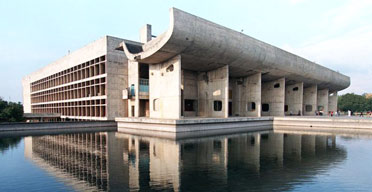
He proposed a designs called “The Radiant City” and the “Contemporary City” which included the complete demolition of the old Parisian cityscape save a select few historical monuments, and the building of an industrial-based much more efficient city with elements such as communal catering in the basement of buildings, day care, vast amounts of parks and elevated transportation (Kennedy). Finally, Le Corbusier was able to put these ideas into action on a small scale in 1946, the French government commissioned Le Corbusier to construct The Marseille project (unité d'habitation, see right), which was completed in 1952; it consisted of “a vertical community of 18 floors. The 1,800 inhabitants are housed in 23 types of duplex (i.e., split-level) apartments. Common services include two “streets” inside the building, with shops, a school, a hotel, and, on the roof, a nursery, a kindergarten, a gymnasium, and an open-air theatre” (Choay). For the first time, Le Corbusier was able to manifest his atypical ideas on a large scale outside of France when in 1951 he was named architectural advisor for the construction of Punjab’s new capital, Chandgarh (see below). His characteristic “unfinished concrete, with windows sheltered by enormous concrete sunshades, the sculptural facades, swooping rooflines, and monumental ramps” completely disregarded the established cultural architecture, but still managed to influence designers all over the world (Choay).
Death and Legacy
Le Corbusier’s disregard for contemporary styles and ideals proved true to his core till the end of his days. In direct contempt of his doctor’s orders, the 77-year-old Le Corbusier went for a swim in the Mediterranean sea, and was assumed to have suffered a heart attack after his body was found. His revolutionary influences can be found in many countries, and as the former President of the United States Lyndon B. Johnson said, "his influence was universal and his works are invested with a permanent quality possessed by those of very few artists in our history." Le Corbusier’s (still) modern approach to city planning and his consideration for the industrial worker’s needs combined in a futuristic simplicity which still offers its usefulness today. William Curtis best recapitulates Le Corbusier’s artistic and revolutionary impact, “With distance, their role shifted to that of historical exemplars and these have since been experienced, reinterpreted, absorbed, internalised and transformed in unexpected and unpredictable ways. In the process they have been cross-bred with diverse intentions, societal agendas and architectural traditions. Each generation 'finds' its own version of Le Corbusier…. Machinism and nature, modernity and tradition, the universal and the local (to name some of the recurrent polarities) coexist as forces within a complex structure of thought, feeling and form. It is precisely because they contain these oppositions that Le Corbusier's prototypes can be read in such diverse ways” (Le Corbusier).
Sources Cited:
Choay, Françoise. “Le Corbusier Biography.” Biography.com. 1994-2008 Encyclopædia Britannica, Inc. 3 Aug. 2009. <http://www.biography.com/articles/Le-Corbusier-9376609?print>.
Curtis, William J. R. "Le Corbusier." Architectural Review 223, no. 1340 (October 2008): 84-87. Academic Search Complete, EBSCOhost. 27 July, 2009.
Kennedy, Rachel. “LeCorbusier and the Radiant City Contra: True Urbanity and the Earth.” 28 July, 2009. <http://www.uky.edu/Classes/PS/776/Projects/Lecorbusier/lecorbusier.html >
“Le Corbusier.” Famous Architects. 3 Aug. 2009. < http://architect.architecture.sk/le-corbusier-architect/le-corbusier-architect.php>
Rybczynski, Witold. “Le Corbusier.” June 8, 1998. Time Inc. 27 July, 2009. http://www.time.com/time/time100/artists/profile/lecorbusier.html


I wouldn't say that his work is boring. I think his building design is effcient. You can get many rooms for say schooling or apartments in such a design. Some large buildings have no room for offices and sometimes don't even meet the needs of their purchasers. So I woud say that Le Corbusier was a very important person in the era for building design.
ReplyDelete