
Aleksandr Mikhailovich Rodchenko, also known as Alexander Rodchenko was a man of many titles and identities. He was an artist, sculptor, photographer, and graphic designer. With all of these titles, he is best known for being the one of the founders of constructivism and Russian design. He was influenced by the Futurists, Cubism and Art Nouveau. His entire philosophy on cultural and graphic design can be captured in one, symbolic quote which represents how he felt the audience should view a certain object. “In order to educate man to a new longing, everyday familiar objects must be shown to him with totally unexpected perspectives and in unexpected situations. New objects should be depicted from different sides in order to provide a complete impression of the object.” Alexander Rodchenko will forever be considered an artist, even a graphic genius by the general public. But to his followers, he will be much more than that.


Born in St. Petersburg, Russia on December 5th, 1891 into a working class family, his father Mikhail Mikhailovich Rodchenko was a theatre designer. His mother, Olga Evdokimovna, was a laundress. From 1908-1910 Rodchenko was a dental technician at Dental School of Dr. Natanson. After his father passed away in 1909, Alexander and his family moved to Kazan. At this point in his life, he studied at the Kazan School of Art under Nikolai Feshin and Georgii Medvedev, and at the Stroganov Institute in Moscow. Here he began his artistic identity creating abstract drawing influenced by the piece Suprematism of Kazimir Malevich. While studying, he also gave lessons in drawing and painted decoration for clubs. Then, in 1916, he participated in "The Store," an exhibition organized by Vladimir Tatlin, who was another formative influence in his development as an artist. Rodchenko experienced the influence of Kazimir Malevich, Vladimir Tatlin, Wassily Kandinsky, and other artists working in abstract style. He was the pupil and assistant of Vladimir Tatlin, and his work was initially influenced by Cubism, then Cubo-Futurism. His early drawings and paintings followed the developments of Suprematism and Futurism. He worked with a wide variety of media as a decorator, furniture and theatre designer, printer, painter, sculptor, and photographer. After the Russian Revolution of 1917, Rodchenko joined the Bolsheviks. He believed in new opportunities for art and became active in many applications of art, illustration, commercial designs, and photography. He used his talent to help push the Bolshevik party forward. 
Rodchenko was also involved in theater, designing the costumes and props for Glebov's Pendulum and The Bed Bug in 1929, and was one of Russia's foremost painters, collagists and poster artists. Rodchenko began photo-reporting in 1926, working for the magazines Ogonok, Radioslushatel, Prozhektor, Krasnoye Studenchestvo, Dayosh, Za rubezhom, Smena, Borba klassov and the daily Vechernaya Moskva, among others. In 1932 the photographer, whose work was - and still is - widely exhibited, began working in photomontage. Throughout his entire life, Rodchenko could be considered one of the earliest photo-collagists. Some of his favorite themes were sports, the circus, festive processions and the Soviet way of life. He included a wide variety of settings for his photographs, thus allowing him to create different moods and feelings from his artwork.
Alexander was also a man of film and the big screen. Rodchenko shot a newsreel series directed by Dziga Vertov, originally called Kino-Pravda and later called One-sixth of the World, which was begun in 1922. Between 1927 and 1930 he was "constructor-artist" of the films The Woman Journalist, Moscow in October, Albidum, The Puppet Millionaire and What Shall I be?. He also directed the documentary The Chemicalization of the Forest. Rodchenko’s main artistic love was the camera and the photograph. This is what he is best recognized for and I feel these are his true masterpieces. Alexander Rodchenko wrote a manifesto titled "Against the Synthetic Portrait, For the Snapshot" in which he argues for the documentary objectivity of photography. He also created several photo-albums for Soviet propaganda, such as: "Belomor-kanal imeni Stalina" and "Krasnaya Armia."

“The viewer who sees only a study in the picture of the glass jug illuminated from behind fails to appreciate the masterly composition, the noble purity of the lines, the rich plasticity of the form and consequently also the poetry and beauty of the picture, and still more important, its specifically photographic qualities"
-Karginov, Rodchenko-
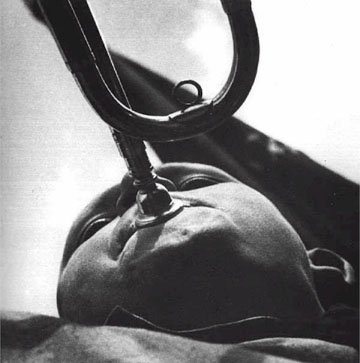
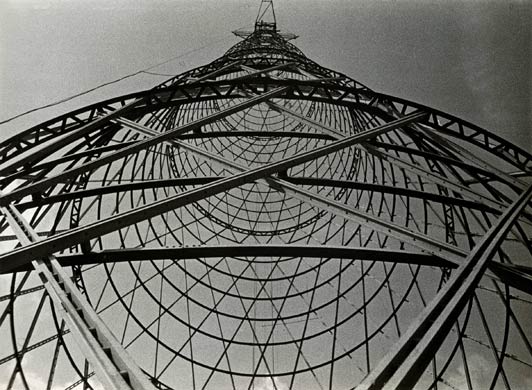
His innovations revolutionized the art of still photography. He used his camera as if it was a drawing instrument. He mastered the use of photo-montage, odd angles, wide frames, and photo-series. His way of photographing from unusual and obscured viewpoints, exploring the potential of shadows, opened new dimensions in photo-art. Rodchenko shot his subjects from high above or below angles, to shock the viewer and to postpone recognition. He wanted to incorporate his own imagery into the photomontages. During his artistic life, he became inspired by his work in illustration and commercial designs. Like I said before, Alexander Rodchenko became one of the founders of Constructivism and Productivism in Russia. His innovations revolutionized the art of still photography. He used his camera as if it was a drawing instrument. He mastered the use of photo-montage, odd angles, wide frames, and photo-series. His way of photographing from unusual and obscured viewpoints, exploring the potential of shadows, opened new dimensions in photo-art. Rodchenko shot his subjects from high above or below angles, to shock the viewer and to postpone recognition. In 1921, Russian avant-garde artist Alexander Rodchenko executed what were arguably some of the first true monochromes (artworks of one color), and proclaimed "I reduced painting to its logical conclusion and exhibited three canvases: red, blue, and yellow.” For artists of the Russian Revolution, Rodchenko's radical action was full of utopian possibility. It marked the end of easel painting – perhaps even the end of art – along with the end of bourgeois norms and practices. It cleared the way for the beginning of a new Russian life, a new mode of production, a new culture.
From the late 1930's to the end of his life in 1956, he was forced to quit photography amidst the paranoia of Stalinist censorship. He returned to painting sporadically after 1942, made a series of abstract decorative compositions, but his art was ostracized. He lived in poverty and obscurity for the last twenty years of his life. Rodchenko was constantly harassed by officials for his art, his membership in the Union of Soviet Artists was canceled, and he was made an outcast. His membership was restored only in 1954, after the death of Stalin. Rodchenko died of a stroke on December 3, 1956, in Moscow, and was laid to rest in Donskoe Cemetery in Moscow, Russia. Aleksandr Mikhailovich Rodchenko was one of the most versatile Constructivist and Productivist artists to emerge after the Russian Revolution. His artistic work and photographs will forever live on and inspire those who need inspiration.

Rodchenko was also involved in theater, designing the costumes and props for Glebov's Pendulum and The Bed Bug in 1929, and was one of Russia's foremost painters, collagists and poster artists. Rodchenko began photo-reporting in 1926, working for the magazines Ogonok, Radioslushatel, Prozhektor, Krasnoye Studenchestvo, Dayosh, Za rubezhom, Smena, Borba klassov and the daily Vechernaya Moskva, among others. In 1932 the photographer, whose work was - and still is - widely exhibited, began working in photomontage. Throughout his entire life, Rodchenko could be considered one of the earliest photo-collagists. Some of his favorite themes were sports, the circus, festive processions and the Soviet way of life. He included a wide variety of settings for his photographs, thus allowing him to create different moods and feelings from his artwork.

Alexander was also a man of film and the big screen. Rodchenko shot a newsreel series directed by Dziga Vertov, originally called Kino-Pravda and later called One-sixth of the World, which was begun in 1922. Between 1927 and 1930 he was "constructor-artist" of the films The Woman Journalist, Moscow in October, Albidum, The Puppet Millionaire and What Shall I be?. He also directed the documentary The Chemicalization of the Forest. Rodchenko’s main artistic love was the camera and the photograph. This is what he is best recognized for and I feel these are his true masterpieces. Alexander Rodchenko wrote a manifesto titled "Against the Synthetic Portrait, For the Snapshot" in which he argues for the documentary objectivity of photography. He also created several photo-albums for Soviet propaganda, such as: "Belomor-kanal imeni Stalina" and "Krasnaya Armia."

“The viewer who sees only a study in the picture of the glass jug illuminated from behind fails to appreciate the masterly composition, the noble purity of the lines, the rich plasticity of the form and consequently also the poetry and beauty of the picture, and still more important, its specifically photographic qualities"
-Karginov, Rodchenko-
His innovations revolutionized the art of still photography. He used his camera as if it was a drawing instrument. He mastered the use of photo-montage, odd angles, wide frames, and photo-series. His way of photographing from unusual and obscured viewpoints, exploring the potential of shadows, opened new dimensions in photo-art. Rodchenko shot his subjects from high above or below angles, to shock the viewer and to postpone recognition. He wanted to incorporate his own imagery into the photomontages. During his artistic life, he became inspired by his work in illustration and commercial designs. Like I said before, Alexander Rodchenko became one of the founders of Constructivism and Productivism in Russia. His innovations revolutionized the art of still photography. He used his camera as if it was a drawing instrument. He mastered the use of photo-montage, odd angles, wide frames, and photo-series. His way of photographing from unusual and obscured viewpoints, exploring the potential of shadows, opened new dimensions in photo-art. Rodchenko shot his subjects from high above or below angles, to shock the viewer and to postpone recognition. In 1921, Russian avant-garde artist Alexander Rodchenko executed what were arguably some of the first true monochromes (artworks of one color), and proclaimed "I reduced painting to its logical conclusion and exhibited three canvases: red, blue, and yellow.” For artists of the Russian Revolution, Rodchenko's radical action was full of utopian possibility. It marked the end of easel painting – perhaps even the end of art – along with the end of bourgeois norms and practices. It cleared the way for the beginning of a new Russian life, a new mode of production, a new culture.
From the late 1930's to the end of his life in 1956, he was forced to quit photography amidst the paranoia of Stalinist censorship. He returned to painting sporadically after 1942, made a series of abstract decorative compositions, but his art was ostracized. He lived in poverty and obscurity for the last twenty years of his life. Rodchenko was constantly harassed by officials for his art, his membership in the Union of Soviet Artists was canceled, and he was made an outcast. His membership was restored only in 1954, after the death of Stalin. Rodchenko died of a stroke on December 3, 1956, in Moscow, and was laid to rest in Donskoe Cemetery in Moscow, Russia. Aleksandr Mikhailovich Rodchenko was one of the most versatile Constructivist and Productivist artists to emerge after the Russian Revolution. His artistic work and photographs will forever live on and inspire those who need inspiration.
Works Cited
"Alexander Michailowitsch Rodtschenko Biography." Art Directory (2009) Web.27 Jul 2009..
Klotz, Alan. "Biography of Aleksandr Mikhailovich Rodchenko ." Photo Collect (1995-1999) Web.26 Jul 2009..
Shelokhonov , Steve. "Biography for Alexander Rodchenko." IMDB (2009) Web.27 Jul 2009. http://www.imdb.com/name/nm0734447/bio.
"Alexander Michailowitsch Rodtschenko Biography." Art Directory (2009) Web.27 Jul 2009.
Klotz, Alan. "Biography of Aleksandr Mikhailovich Rodchenko ." Photo Collect (1995-1999) Web.26 Jul 2009.
Shelokhonov , Steve. "Biography for Alexander Rodchenko." IMDB (2009) Web.27 Jul 2009. http://www.imdb.com/name/nm0734447/bio.
Pictures:




Your paper is my favorite one so far. I love all the things that Rodchenko did. His art was revolutionary for the time. Your paper was really well written. I really like how you explained each art piece.
ReplyDeleteWhat I enjoy about your artist is his spectrum of art production. He is well known as an original photo-montage...ist? But I personally was fasinated by his propoganda work. Good work here!
ReplyDeleteThank you for your paper! I learned a great deal about an artist I didn't know of before. It is amazing how talented and how involved in different projects he was. I'm glad you took the time to give examples of the different bodies of work he did. Great job!
ReplyDelete